

The 500-Metre Boundary: A Definitive Architectural Guide to CRZ Compliance for Goa Villa Developers
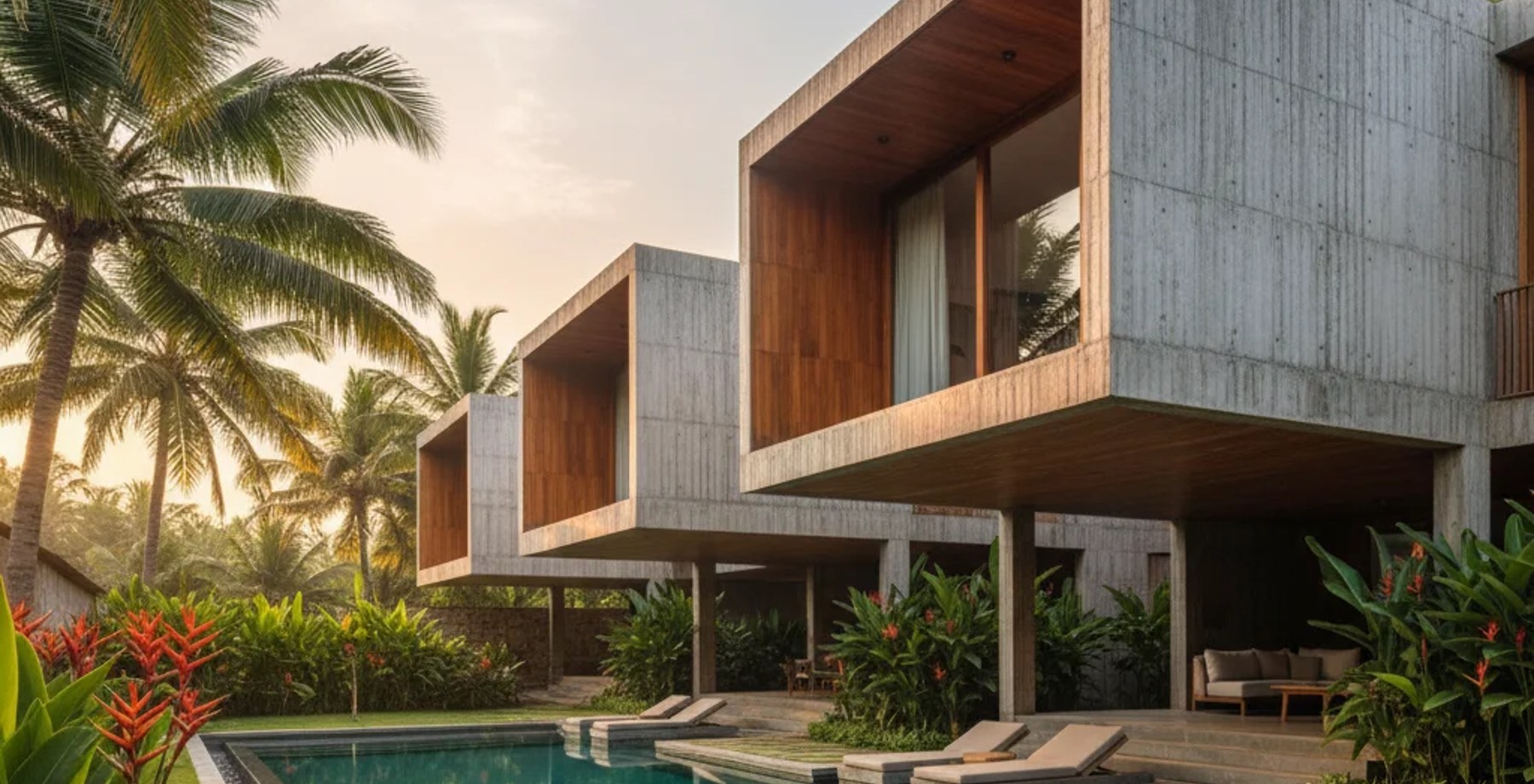
Table of Contents (6 sections)▼
The Architectural Imperative: Precision in the Coastal Zone
or the discerning developer or villa buyer in Goa, the coastline is not merely a scenic backdrop; it is a strictly regulated legal boundary. The Coastal Regulation Zone (CRZ) Notification 2019, enforced by the Ministry of Environment, Forest and Climate Change (MoEFCC) and the Goa Coastal Zone Management Authority (GCZMA), dictates the spatial logic of every structure within 500 metres of the High Tide Line (HTL).
Ignoring these regulations is not a risk; it is a guarantee of financial loss. Structures built in violation of CRZ norms are subject to immediate demolition without compensation. As Chief Architectural Editor at ERENDERS, I have observed that the most successful coastal projects in Goa are those where architectural vision is subservient to regulatory precision. This guide dissects the four CRZ zones to help you navigate the complex interplay between ecological sensitivity, urban density, and high-end villa construction.
Decoding the Four CRZ Zones: A Regulatory Matrix
Understanding your plot’s classification is the first step in any architectural feasibility study. The CRZ framework divides the coastal strip into four distinct zones, each with specific construction permissions.
#### The No Development Zone (NDZ): The Critical Buffer
The most critical concept for villa buyers is the No Development Zone (NDZ). In CRZ-III areas, which encompass the majority of Goa’s coastal land, the NDZ is a strict buffer where no new construction is permitted.
- CRZ-III A: 50 metres from HTL.
- CRZ-III B: 200 metres from HTL.
If your plot falls within this buffer, new construction is legally impossible. However, if a structure legally existed prior to the CRZ notification (1991 for urban, later for rural) and you possess documentary proof, renovation and repair to the same footprint and floor area are generally permitted. Expansion is strictly prohibited without specific GCZMA clearance, which is rarely granted for residential expansion in the NDZ.
Architectural Strategy for Compliant Villa Design
For plots located between the NDZ and the 500-metre limit (particularly in CRZ-III B), development is possible but heavily regulated. The architectural response must balance luxury with compliance.
#### 1. Height and Coverage Constraints In CRZ-III zones, where construction is permitted (200–500m from HTL), the following limits apply:
- Maximum Height: 9 metres (typically Ground + 1 floor).
- Maximum Coverage: 33% of the plot area.
This constraint demands a low-rise, horizontal architectural language. The villa must spread out rather than stack up. This is an opportunity for a sprawling, single-story luxury residence with expansive terraces, rather than a vertical tower.
#### 2. Material Engineering for Coastal Durability Coastal architecture in Goa faces a unique set of environmental challenges: high humidity, salt spray, and intense UV radiation. Standard materials will fail. ERENDERS specifies a high-performance material palette for CRZ-compliant villas:
- Glazing: Schüco aluminum systems with low-E, argon-filled double glazing. These systems provide thermal insulation and are engineered to resist salt corrosion, ensuring energy efficiency and longevity in the humid coastal climate.
- Hardware: SS316 Marine-Grade Stainless Steel for all exterior fixtures, railings, and door handles. Unlike standard SS304, SS316 contains molybdenum, which significantly enhances resistance to chloride-induced pitting from sea spray.
- Stone Cladding: Statuario Marble for interior feature walls and select exterior accents. While marble is porous, when properly sealed with penetrating crystalline sealants, it offers a timeless aesthetic. For exterior facades, we recommend Kashmir White Granite or Basalt, which are more resistant to weathering and salt erosion.
- HVAC: Daikin VRV (Variable Refrigerant Volume) systems. These provide zoned climate control, essential for a low-rise villa with large glazing areas. VRV systems are energy-efficient and can handle the high latent load of Goa’s humidity.
Regulatory Protocol: A 5-Step Due Diligence Process
Before finalizing any purchase or commencing design, you must execute the following regulatory protocol. This is non-negotiable.
Execution Timeline for CRZ-Compliant Villa Construction
A typical timeline for a CRZ-compliant villa in Goa, from land acquisition to handover, is as follows:
- Months 1–2: Due Diligence & CRZ Clearance Verification.
- Months 3–5: Architectural Design & GCZMA/MoEFCC Approval Process. (This is the most variable phase; allow for 3–6 months for regulatory approvals).
- Months 6–18: Construction. (12–18 months for a high-end villa, including foundation, structure, and finishes).
- Months 19–20: Final Inspections & Handover.
Critical Note: The regulatory approval phase is the longest bottleneck. Starting this process early is essential to avoid project delays.
Why ERENDERS?
Navigating the CRZ landscape requires more than just architectural skill; it demands legal acumen, regulatory expertise, and a commitment to sustainable, high-performance design. At ERENDERS, we specialize in turnkey interior architecture and society redevelopment in India, with a dedicated focus on coastal compliance.
Our team of architects, engineers, and legal consultants works in tandem to ensure that your villa is not only a masterpiece of design but also a legally secure asset. We handle the entire process, from CRZ verification and regulatory approvals to the execution of high-end finishes using premium materials like Schüco glazing and Daikin VRV systems.
Don’t let regulatory uncertainty jeopardize your investment.
[Contact ERENDERS for a CRZ Compliance Audit & Architectural Consultation](https://erenders.in/contact)
Have a critique or feedback on this architectural concept? Join 1,200+ architects and 3D artists in the Roastitects Community Debate Arena.
JOIN ROASTITECTS DEBATE →Frequently Asked Questions
Technical Q&A from this article — answers expanded for depth and SEO.
Looking for more architectural research & spatial studies?
Browse full-width editorial essays, LOD technical specs, and audio folios in the Community Folio.
Just published
10 Stories to Know Right Now
3 stories
- 01ARCHITECTURE9 min reading timeOct 29, 2026BIM & Revit Outsourcing for Indian Architecture Firms: Workflow, LOD Standards & Cost BenchmarksERENDERS Editorial Staff
- 02ARCHITECTURE8 min reading timeOct 24, 2026NRI Remote Home Construction in India: The 3D Digital Twin & Milestone Quality ProtocolERENDERS Editorial Staff
- 03ARCHITECTURE11 min reading timeSep 15, 2026Climate-responsive Villa Elevation Designs in Coastal Hubs:
Studio selection
The Creator's Choice
5 picks
- 01ARCHITECTURE11 min reading timeSep 15, 2026Climate-responsive Villa Elevation Designs in Coastal Hubs:
- 02ARCHITECTURE9 min reading timeOct 29, 2026BIM & Revit Outsourcing for Indian Architecture Firms: Workflow, LOD Standards & Cost BenchmarksERENDERS Editorial Staff
- 03ARCHITECTURE8 min reading timeOct 24, 2026NRI Remote Home Construction in India: The 3D Digital Twin & Milestone Quality ProtocolERENDERS Editorial Staff