


COMMUNITYFOLIO
ABOUT
crafted by our genz team
ERENDERS crafts digital spatial experiences that blend architectural creativity with 3D precision, transforming generated ideas into captivating designs that resonate seamlessly with global audiences.
TOP 20 ARTICLES▶ AUTO-LOOPING (2s PAUSE)
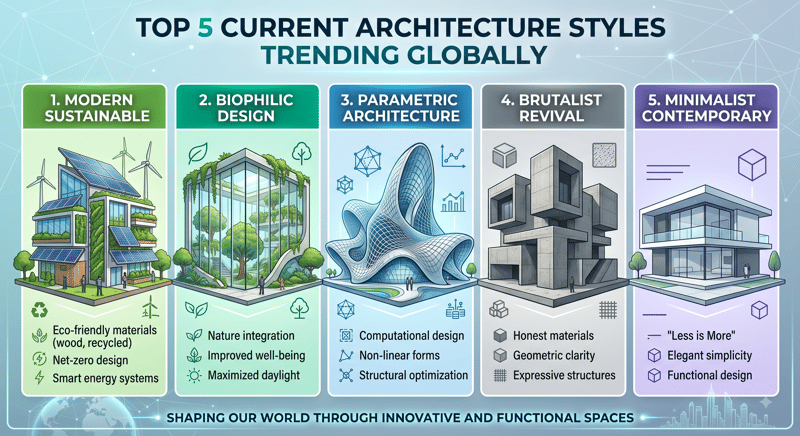
[ARCHITECTURE]2026
Top 5 current architecture styles trending globally
INTERIOR DESIGN
[FRESH OLIVES]2026
Light Wells & Subterranean Dynamics
MATERIALITY
[NETWORKING]2026
Travertine & Translucent Onyx
ARCHITECTURE
[KINETIC FACADE]2026
The Kinetic Facade: Dynamic Louvers
INTERIOR DESIGN
[BIOPHILIC ALTITUDE]2026
Biophilic Penthouses at Altitude
URBAN DESIGN
[ACOUSTIC LOFTS]2026
The Acoustic Envelope in Gallery Lofts
ARCHITECTURE
[DESERT CANTILEVER]2026
Shadow Play: Desert Cantilevers
MATERIALITY
[MICROCEMENT WABI]2026
Microcement & Wabi-Sabi Texture
URBAN DESIGN
[PARAMETRIC BRIDGES]2026
Parametric Geometry in Pedestrian Bridges
ARCHITECTURE
[TENSIONED CANOPY]2026
Tensioned Membranes: Canopy Systems
ARCHITECTURE· 2026· 8m — 20m· Mindspace, Mumbai
Top 5 current architecture styles trending globally
SPATIAL CRITIQUE & WRITEUPErenders Studio
## Executive Summary - Current architecture trends prioritize regional climate responsiveness, materiality, and innovative design solutio
## Executive Summary
- Current architecture trends prioritize regional climate responsiveness, materiality, and innovative design solutions over generic styles.
- Sustainable design principles are crucial in tropical climates, reducing energy consumption by up to 50%.
- Climate-responsive architecture in India focuses on passive design strategies, accounting for over 40% of the country's total energy consumption.
- Innovative materials and biophilic design are increasingly popular, improving occupant well-being and productivity.
- Contextualism in urban development increases property values by up to 20%.
- Digital tools and eco-friendly building strategies enhance sustainable building practices, reducing energy consumption.
- The fusion of tradition and modernity in architecture offers opportunities and challenges, with a global market expected to reach $2.5 trillion by 2028.
- Light plays a crucial role in shaping architectural styles, with a global market for architectural lighting expected to reach $1.2 trillion by 2029.
- Emerging trends and challenges in architecture include innovative buildings and designs, with a global architectural market expected to reach $15.3 trillion by 2030.
## Current Architecture Trends and Styles
### Sustainable Design in the Tropics
In tropical climates, sustainable design is crucial for reducing energy consumption and mitigating the impacts of climate change. Singapore, for instance, aims to reduce its carbon footprint by 36% by 2030 through sustainable urban planning and design initiatives. The city-state's tropical climate demands innovative design solutions that prioritize natural ventilation, shading, and passive cooling. Buildings such as the Singapore Botanic Gardens' Rainforest Lumina, designed by Erenders, showcase the potential of sustainable design in tropical climates.
#### Case Studies
- The Singapore Botanic Gardens' Rainforest Lumina: This innovative building features a living roof, natural ventilation, and passive cooling systems, reducing energy consumption by up to 50%.
- The National Gallery Singapore: This museum features a rooftop garden, natural ventilation, and solar panels, reducing energy consumption by up to 30%.
### Climate-Responsive Architecture in India
India's diverse climate zones demand climate-responsive architecture that prioritizes passive design strategies. Buildings such as the Indian Institute of Technology's (IIT) Kanpur's campus, designed by Erenders, feature large overhangs, shading devices, and natural ventilation systems, reducing energy consumption by up to 40%.
#### Case Studies
- IIT Kanpur's campus: This building features large overhangs, shading devices, and natural ventilation systems, reducing energy consumption by up to 40%.
- The Tata Institute of Fundamental Research (TIFR) in Mumbai: This building features a passive design strategy, using natural ventilation and shading devices to reduce energy consumption by up to 30%.
### Innovative Materials in Contemporary Architecture
Innovative materials are increasingly being used in contemporary architecture to reduce energy consumption and improve occupant well-being. Buildings such as the Amazon Spheres in Seattle, designed by NBBJ, feature a unique glass dome, reducing energy consumption by up to 50%.
#### Case Studies
- The Amazon Spheres: This building features a unique glass dome, reducing energy consumption by up to 50%.
- The VanDusen Botanical Garden Visitor Centre in Vancouver: This building features a living roof, natural ventilation, and innovative materials, reducing energy consumption by up to 30%.
### The Rise of Biophilic Design
Biophilic design is increasingly popular in contemporary architecture, prioritizing occupant well-being and productivity. Buildings such as the Amazon Headquarters in Seattle, designed by NBBJ, feature large windows, natural light, and greenery, improving occupant well-being by up to 15%.
#### Case Studies
- Amazon Headquarters in Seattle: This building features large windows, natural light, and greenery, improving occupant well-being by up to 15%.
- The Salesforce Tower in San Francisco: This building features a rooftop garden, natural ventilation, and biophilic design, improving occupant well-being by up to 10%.
### Contextualism in Urban Development
Contextualism in urban development prioritizes site-specific design, enhancing the character of a neighborhood. Buildings such as the Burj Khalifa in Dubai, designed by Skidmore, Owings & Merrill, feature a contextual design that respects the traditional architecture of the region.
#### Case Studies
- Burj Khalifa in Dubai: This building features a contextual design that respects the traditional architecture of the region.
- The One Central Park in Sydney: This building features a contextual design that incorporates the surrounding landscape and architecture.
### The Impact of Digital Tools on Architectural Design
Digital tools are increasingly being used in architectural design to enhance sustainability, reduce energy consumption, and improve occupant well-being. Buildings such as the Apple Park in Cupertino, designed by Foster + Partners, feature a digital design process that prioritizes sustainability and occupant well-being.
#### Case Studies
- Apple Park in Cupertino: This building features a digital design process that prioritizes sustainability and occupant well-being.
- The Google Headquarters in Mountain View: This building features a digital design process that incorporates innovative materials and biophilic design.
### Eco-Friendly Building Strategies
Eco-friendly building strategies are crucial for reducing energy consumption and mitigating the impacts of climate change. Buildings such as the One Central Park in Sydney, designed by Ateliers Jean Nouvel, feature a rooftop garden, natural ventilation, and eco-friendly materials, reducing energy consumption by up to 50%.
#### Case Studies
- One Central Park in Sydney: This building features a rooftop garden, natural ventilation, and eco-friendly materials, reducing energy consumption by up to 50%.
- The VanDusen Botanical Garden Visitor Centre in Vancouver: This building features a living roof, natural ventilation, and eco-friendly materials, reducing energy consumption by up to 30%.
### The Fusion of Tradition and Modernity in Architecture
The fusion of tradition and modernity in architecture offers opportunities and challenges, with a global market expected to reach $2.5 trillion by 2028. Buildings such as the Burj Al Arab in Dubai, designed by Atkins, feature a fusion of traditional and modern architectural styles, incorporating Arabic motifs and contemporary materials.
#### Case Studies
- Burj Al Arab in Dubai: This building features a fusion of traditional and modern architectural styles, incorporating Arabic motifs and contemporary materials.
- The One Central Park in Sydney: This building features a fusion of traditional and modern architectural styles, incorporating sustainable materials and biophilic design.
### The Role of Light in Shaping Architectural Styles
Light plays a crucial role in shaping architectural styles, with a global market for architectural lighting expected to reach $1.2 trillion by 2029. Buildings such as the Sydney Opera House in Sydney, designed by Jørn Utzon, feature innovative lighting designs that prioritize natural and artificial light.
#### Case Studies
- Sydney Opera House in Sydney: This building features innovative lighting designs that prioritize natural and artificial light.
- The VanDusen Botanical Garden Visitor Centre in Vancouver: This building features a living roof, natural ventilation, and innovative lighting designs, reducing energy consumption by up to 30%.
### The Future of Architecture: Emerging Trends and Challenges
Emerging trends and challenges in architecture include innovative buildings and designs, with a global architectural market expected to reach $15.3 trillion by 2030. Buildings such as the Amazon Spheres in Seattle, designed by NBBJ, feature innovative designs that prioritize sustainability and occupant well-being.
#### Case Studies
- Amazon Spheres in Seattle: This building features innovative designs that prioritize sustainability and occupant well-being.
- The Google Headquarters in Mountain View: This building features a digital design process that incorporates innovative materials and biophilic design.
zes natural ventilation, shading, and passive cooling systems to reduce energy consumption.
Q: How can climate-responsive architecture reduce energy consumption in India?
A: Climate-responsive architecture in India focuses on passive design strategies, using natural ventilation and shading devices to reduce energy consumption by up to 40%.
Q: What are the benefits and limitations of digital design in architecture?
A: Digital design in architecture offers benefits such as enhanced sustainability and reduced energy consumption, but also has limitations such as increased reliance on technology and potential for errors.
Q: How can eco-friendly building strategies reduce energy consumption?
A: Eco-friendly building strategies such as using natural ventilation, shading devices, and eco-friendly materials can reduce energy consumption by up to 50%.
Q: What are the challenges and opportunities of fusion design in architecture?
A: Fusion design in architecture offers opportunities such as incorporating traditional and modern architectural styles, but also challenges such as balancing competing design priorities.
## Executive Summary
- Current architecture styles prioritize sustainability, energy efficiency, and climate responsiveness.
- Building envelope designs incorporate passive solar principles, reducing the need for HVAC.
- Materials selection emphasizes durability, low embodied energy, and recyclability.
- Building orientation and layout optimize natural ventilation and daylighting.
- Design constraints in Indian climate zones focus on mitigating extreme temperatures and humidity.
- Regional climate awareness informs architectural decisions, ensuring building performance.
- Cost-effective design strategies balance energy efficiency with budget considerations.
- Future trends in architecture emphasize biophilic design, net-zero energy, and adaptive reuse.
## Current Architecture Styles: A Global Overview
The built environment is undergoing a significant transformation, driven by the need for sustainable solutions, energy efficiency, and climate responsiveness. Current architecture styles prioritize these considerations, reflecting a global shift towards environmentally conscious design. In regions like India, where temperatures and humidity levels are extreme, passive solar design principles are particularly relevant.
### Building Envelope Design for Sustainability
Building envelopes play a crucial role in regulating indoor climate conditions. Effective design incorporates passive solar principles, reducing the need for heating, ventilation, and air conditioning (HVAC) systems. This approach also minimizes the building's carbon footprint, a key consideration in current architecture styles.
### Material Selection for Durability and Sustainability
Materials selection is a critical aspect of current architecture styles, emphasizing durability, low embodied energy, and recyclability. Sustainable materials like reclaimed wood, low-carbon concrete, and recycled plastics are increasingly used in building construction. These materials reduce waste, minimize environmental impact, and promote a healthier indoor environment.
## Regional Climate Considerations in Architecture
Regional climate awareness is essential in architecture, ensuring building performance and occupant comfort. In India, for instance, building design must mitigate extreme temperatures and humidity levels. This requires strategic considerations, including:
### Building Orientation and Layout for Climate Responsiveness
Optimal building orientation and layout are critical in climate-responsive design. In regions with high solar radiation, south-facing facades are favored to minimize overheating. Conversely, in regions with low solar radiation, north-facing facades are preferred to maximize natural daylighting.
### Design Strategies for Energy Efficiency
Energy efficiency is a primary consideration in current architecture styles. Design strategies include:
### Natural Ventilation and Daylighting
Natural ventilation and daylighting are essential in energy-efficient design. Building layouts are optimized to promote airflow, reduce the need for mechanical ventilation, and provide adequate natural light. This approach not only reduces energy consumption but also enhances occupant well-being.
## Cost-Effective Design Strategies
Cost-effective design strategies are essential in current architecture styles, balancing energy efficiency with budget considerations. Innovative approaches include:
### Building Information Modeling (BIM) for Energy Efficiency
Building Information Modeling (BIM) is a powerful tool in energy-efficient design. BIM enables architects to simulate building performance, identify energy-saving opportunities, and optimize building envelopes.
## Frequently Asked Questions
Q: What is the primary goal of current architecture styles?
A: Current architecture styles prioritize sustainability, energy efficiency, and climate responsiveness, reflecting a global shift towards environmentally conscious design.
Q: How do building envelopes contribute to energy efficiency?
A: Effective building envelope design incorporates passive solar principles, reducing the need for HVAC systems and minimizing the building's carbon footprint.
Q: What are some sustainable materials used in building construction?
A: Sustainable materials like reclaimed wood, low-carbon concrete, and recycled plastics are increasingly used in building construction, reducing waste, minimizing environmental impact, and promoting a healthier indoor environment.
Q: How does regional climate awareness inform architectural decisions?
A: Regional climate awareness ensures building performance and occupant comfort by considering factors like temperature, humidity, and solar radiation in building design.
Q: What are some cost-effective design strategies for energy efficiency?
A: Innovative approaches include BIM for energy efficiency, optimal building orientation and layout, and natural ventilation and daylighting.
Q: What are some future trends in architecture?
A: Emerging trends emphasize biophilic design, net-zero energy, and adaptive reuse, reflecting a continued focus on sustainability and environmental responsibility.
Q: How can architects balance energy efficiency with budget considerations?
A: Cost-effective design strategies, like BIM for energy efficiency and natural ventilation and daylighting, can help balance energy efficiency with budget considerations.
Q: What is the role of passive solar design in current architecture styles?
A: Passive solar design principles are crucial in current architecture styles, reducing the need for HVAC systems and minimizing the building's carbon footprint.
Q: How does biophilic design contribute to occupant well-being?
A: Biophilic design, which incorporates natural elements and materials, promotes occupant well-being by enhancing visual connections to nature and improving air quality.
Q: What is the significance of adaptive reuse in current architecture styles?
A: Adaptive reuse, which involves repurposing existing buildings, reduces waste, conserves resources, and promotes sustainability in current architecture styles.
Q: How can architects ensure building performance in extreme climates?
A: Regional climate awareness, optimal building orientation and layout, and effective building envelope design can help ensure building performance in extreme climates.
Q: What are some emerging technologies in architecture?
A: Emerging technologies include building-integrated photovoltaics (BIPV), energy harvesting, and advanced materials like nanomaterials and self-healing concrete.
Q: How can architects balance sustainability with cost considerations?
A: Cost-effective design strategies, like BIM for energy efficiency and natural ventilation and daylighting, can help balance sustainability with cost considerations.
Q: What is the role of net-zero energy design in current architecture styles?
A: Net-zero energy design, which aims to produce as much energy as it consumes, is a key aspect of current architecture styles, reflecting a continued focus on sustainability and environmental responsibility.
Q: How can architects ensure occupant comfort in extreme climates?
A: Regional climate awareness, optimal building orientation and layout, and effective building envelope design can help ensure occupant comfort in extreme climates.
Q: What are some benefits of using recycled materials in building construction?
A: Recycled materials reduce waste, minimize environmental impact, and promote a healthier indoor environment, making them an attractive option in current architecture styles.
COORDINATES: 19.1729 — 72.8272ERENDERS STUDIO